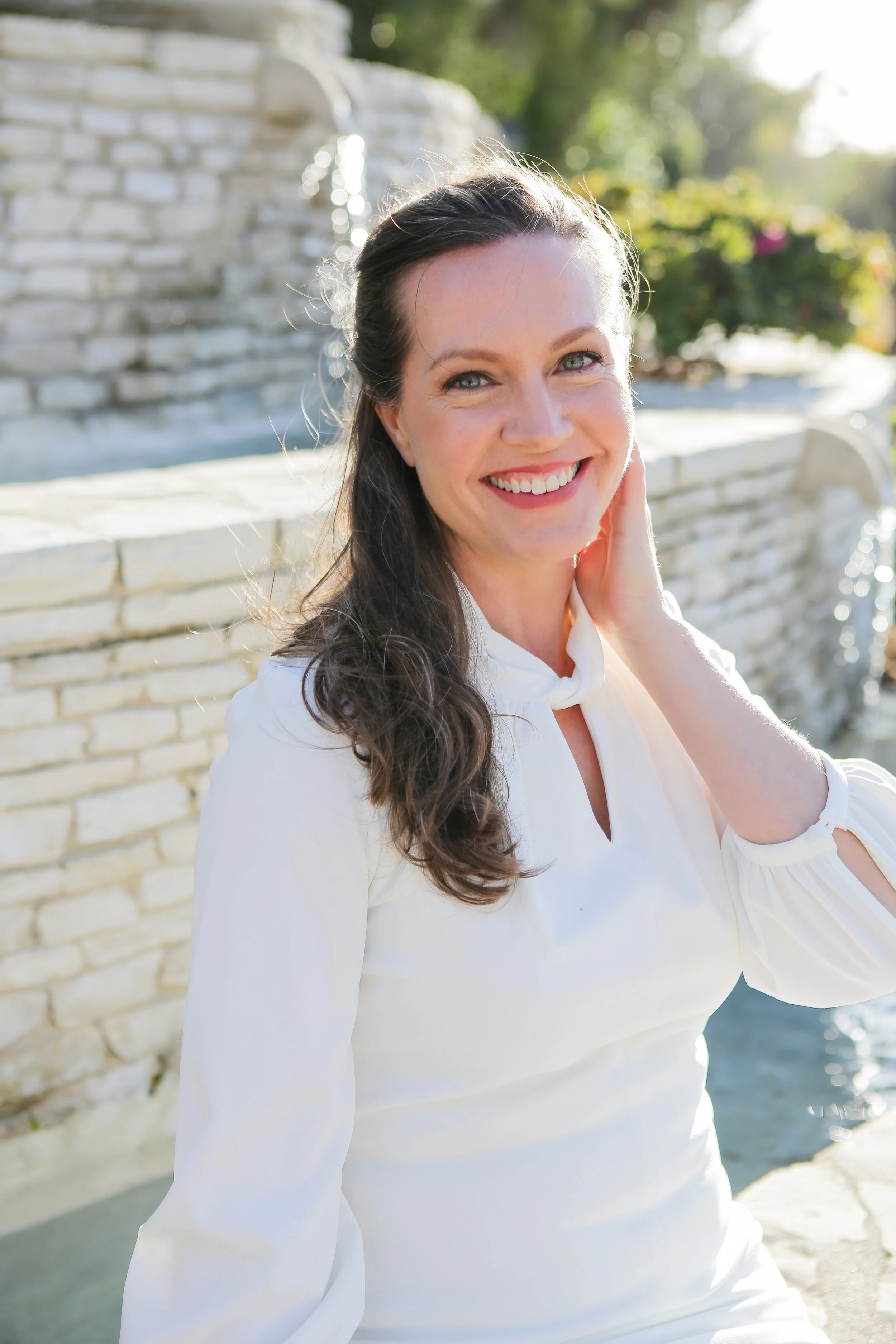
Lauren Polly is an award-winning author, speaker and speech-language pathologist whose work explores identity, expression, communication, connection and aliveness.
She is the author of the bestselling, multi-award-winning The Other Side of Bipolar and the writer behind Mental Wealth.
Drawing from more than 20 years in communication and her own experience of moving beyond a defining mental health label, Lauren explores how we become fluent in The Version That Works—and what can happen when we create enough breathing room for more of ourselves to participate in our lives.
I’ve spent most of my life wondering what else is there.
What else is inside a person beyond what we can currently see? Beyond the words they can find, the role they play, the label they’ve been given, or the version of themselves they’ve become really good at being?
I didn’t always know these questions were connected. They came out of two very different parts of my life—one personal and one professional—that I was walking at the same time.
Looking back now, I think they were teaching me remarkably similar things.
At 14, I was diagnosed with bipolar disorder.
Fourteen is already a strange age to be figuring out who you are. Add a mental health diagnosis into the mix, and suddenly you have a pretty powerful explanation for parts of yourself you’re only beginning to understand.
The diagnosis gave language to things I was experiencing, and some of that was helpful.
But it also changed the way I watched myself.
I started noticing which parts of me seemed acceptable and which could be interpreted as symptoms. The creative parts, the wild parts, the less predictable parts of me became things I learned to monitor and control.
And I got very good at it.
For a long time, I thought that was what getting better looked like.
Eventually, though, I started wondering how much of myself I had learned to control right out of my life.
That question changed a lot for me.
For more than 20 years, I’ve worked as a speech-language pathologist.
I’ve sat with people who know exactly what they want to say but can’t find the words. I’ve worked with people whose ability to communicate has changed dramatically, while their preferences, humor, intelligence, memories, desires, and personalities are still very much there.
You learn something important doing this work:
There can be so much more inside a person than what is currently making it outside.
And expression matters for reasons that go way beyond exchanging information.
It’s how I tell you what I want. What matters to me. What hurts. What I find funny. What I disagree with. What I remember. What I need.
It’s one of the ways I let you know me.
For years, I was helping other people find ways to bring more of what was inside them into expression while, in my own life, I was trying to figure out what I had stopped expressing.
I was helping others use their voice while learning to trust my own.
I didn’t make that connection immediately.
But now it seems almost impossible to miss.
Eventually, my personal explorations became a book.
I started questioning whether becoming very good at managing a diagnosis was really the end of the story for me.
What if some of the qualities I had learned to fear didn’t need to be eliminated?
What if I could understand them differently?
What if the diagnosis could be true without being the whole truth of who I was?
That exploration eventually became my bestselling, multi-award-winning book, The Other Side of Bipolar.
I dedicated it:
“To those who know more is possible than what they’ve been told they can have and be.”
For those who, like me, have been given a box to live inside. Feeling the urge to break free, being fearful of doing so, but ultimately seeing no path forward without taking the leap.
At the time, I was writing very specifically about my experience with mental health.
But over the years, I started noticing the same basic human pattern in places that had nothing to do with diagnosis.
We’re all given roles, definitions, and labels. They create a version of ourselves that we know, others expect, and we get very good at playing.
They become a version of ourselves that works in our lives, but they aren’t the whole of who we are or what we’re capable of becoming.
At the same time, communication became my life’s work.
Maybe you become the dependable one. The smart one. The leader. The caretaker. The easygoing one. The expert. The one who can always handle it.
We read our families, schools, workplaces, relationships and communities, and we learn which ways of being help us belong, succeed, stay safe and be understood.
That’s not a flaw. It’s something human beings are incredibly good at doing.
The part that interests me is when “this is a way I know how to be” starts becoming “this is who I am.”
I’ve started calling that The Version That Works.
And I don’t think The Version That Works is fake or something we need to get rid of.
It may have built your career, helped you through a difficult time, held relationships together, or made you excellent at what you do.
It worked.
The problem is that sometimes it works so well, we mistake it for all that we are.
And this is where things can start to feel a little strange.
You can have a successful life and still feel flat inside it. You can be surrounded by people and not feel deeply known. You can be grateful for what you have and also have a nagging sense that something is missing.
Sometimes nothing looks particularly wrong.
Technically, a lot may be right.
And yet you find yourself wondering:
Why don’t I feel more alive inside the life I’ve built?
That question is a big part of the work I’m interested in now.
I’m not particularly interested in giving people another version of themselves to become.
I think a lot of us are exhausted by that.
Find yourself. Improve yourself. Reinvent yourself. Become your best self. Discover your authentic self.
I’ve spent plenty of my own life in that world, and lately something about it feels off to me.
I don’t know that we always need another self.
I think sometimes we need more range.
What have I stopped expressing because it didn't fit the role I was playing?
What part of me hasn’t had much airtime lately?
Where have my conversations become predictable?
What do I keep editing before anyone else gets to hear it?
What did I used to enjoy that somehow disappeared?
Where have I become so practised at one way of being that I’ve forgotten I can respond differently?
This is what I mean by Recovering Range.
Not blowing up your life.
Not bringing every part of yourself into every room all the time. That sounds exhausting for everyone involved.
And not searching for some perfect, fully expressed version of yourself either.
It’s creating enough breathing room to explore more of what is already there. Trying something differently. Saying the thing you normally edit. Letting someone meet a side of you they haven’t seen before. Reaching for something you haven’t reached for in a long time.
And then seeing what happens.
The goal isn’t to become someone new. It’s to let more of yourself participate in the life you already have.
We all learn what works.
I’m not talking about being happy all the time.
I don’t want that to become another thing we’re supposed to achieve.
Aliveness, to me, has much more range than happiness.
It can be joy and excitement, but it can also be curiosity, desire, grief, uncertainty, play, discomfort, stillness, creativity, connection, disagreement.
It’s being in your life rather than constantly managing yourself through it.
For a lot of my life, I lived with my eyes out. I watched for the signals around me—what was acceptable, what was safe, what was successful, what other people responded well to—and adjusted myself accordingly.
I don't think the answer is to stop paying attention to the world around us. We need each other. We live in relationship with other people.
I’m more interested in what happens when the conversation starts moving both ways.
When we create enough breathing room to notice what is happening inside us too, and then bring more of that into our relationships, our work, our creativity, our conversations and the day-to-day experience of being alive.
Because being seen isn't necessarily the same thing as being known.
And having a life that works isn't necessarily the same thing as fully participating in it.
This is what I explore now.
I explore it on stages and in my writing. Through my Substack, Mental Wealth. In conversations about identity, expression, communication and connection.
Sometimes the doorway is mental health and the labels we’ve carried.
Sometimes it’s professional success and what happens when we become very good at being one version of ourselves.
Sometimes it’s loneliness, even when we're surrounded by people.
Sometimes it’s creativity and wondering where ours went.
And sometimes it’s much harder to name.
Life is good.
You’re doing well.
Nothing is obviously wrong.
You just have the feeling that there might be more of you that could be here for it.
That’s the part I keep getting curious about.